
Towards a Sustainability Standard Grounded in Cultural Practice
Watch the Video Recording of the session
On 10 June 2026, as part of the New European Bauhaus Festival, Culture for the Planet and ICLEI Europe / NEB Junction hosted an online session bringing together arts and cultural organisations globally to explore a question that is becoming increasingly relevant across the sector: What would a sustainability standard look like if it were designed specifically for arts and cultural organisations?
The discussion emerged from a simple observation. Sustainability reporting frameworks, management systems and certification schemes are becoming more widespread, yet many cultural organisations continue to work with tools that were developed for contexts very different from their own. The webinar sought to create a space for collective reflection, drawing on practical experiences from organisations already using these tools and inviting participants to contribute to an ongoing process of co-creation.
When Existing Frameworks Meet Cultural Realities
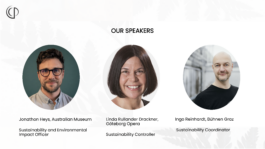
The session opened with contributions from Jonathon Heys (Australian Museum), Linda Rullander Drackner (Göteborg Opera) and Ingo Reinhardt (Bühnen Graz), each sharing their organisation's experience of working with sustainability standards and reporting obligations .
Although their contexts differ significantly, the presentations revealed a few common questions. Existing frameworks can provide structure, legitimacy and a common language for sustainability. They help organisations organise priorities, establish responsibilities and connect sustainability ambitions with operational processes.
As Jonathon Heys observed: "Standards can help to turn aspirations into structured work streams with clear evidence trails."
Yet the presentations also highlighted a more nuanced reality. For example, the need for compliance can overshadow the process of real change.
The discussion raised broader questions about the applicability of standards, their interpretation and implementation across a sector characterised by diversity, experimentation and often limited resources.
From Reporting Requirements to Organisational Learning
As sustainability expectations continue to increase, organisations are being asked to collect more data, monitor more indicators and demonstrate progress in increasingly sophisticated ways. At the same time, participants highlighted the need for dedicated resources for embedding sustainability as core task across entire organisations.
The session reflected on the considerable effort required to establish systems for data collection, monitoring and evaluation. Yet the challenge is not necessarily the absence of information. Rather, it is understanding which information matters, how it can be interpreted and how it can support decision-making.
Ingo Reinhardt reflected: "We have a lot of data. Now I know where to find it." Behind the humour lies a broader question that resonated throughout the discussion: how can sustainability standards support organisational learning without generating a lot of additional reporting requirements?
The conversation suggested that the effectiveness of a standard may depend less on the quantity of data it produces than on its capacity to stimulate reflection, dialogue and informed action involving all teams taking part in artistic production, communication, and visitors experiences. Also, the role of the suppliers was highlighted. As they are often forgotten in sustainability reporting in the context of cultural sector, their role is crucial to ensure holistic change.
What Makes a Sustainability Standard Meaningful?
Participants explored the idea that the value of a sector-specific standard may not lie in creating uniform outcomes or prescribing identical pathways. Arts and cultural organisations operate in different contexts, pursue different missions and engage with different communities. Their sustainability journeys are therefore unlikely to look the same. Yet, there is also a clear wish to establish a common basis. In this context, Linda Rullander Drackner, from Göteborg Opera, shared her dream: “We would also have a common climate calculation tool, a common system for due dilligence and supplier evaluation."
This led to a discussion around the role of standards as enabling frameworks rather than prescriptive instruments. As Leticia Labaronne reflected during the session: "The real value of standards lies not in standardising outcomes, but in harmonising processes."
Rather than reducing diversity, a sustainability standard might help create a shared language and a common point of reference while preserving the plurality that characterises the arts and cultural sector.
Through this lens, the notion of a "beautiful" sustainability standard became less about compliance and more about creating conditions that enable organisations to learn, adapt and thrive. Gioele Racca, from ICLEI Europe / NEB Junction, highlighted the context of New European Bauhaus as a framework that specifically wants to integrate sustainability, inclusion and beauty.
Questions Emerging from the Co-Creation Workshop
The second part of the webinar invited participants to engage directly in the ongoing development of the Culture for the Planet sustainability standard. The participants focused on several aspects:
How can sustainability become embedded within leadership decisions? How can responsibilities be shared across departments while maintaining clear accountability? What forms of stakeholder engagement are needed to support meaningful organisational change? How should sustainability considerations be integrated into procurement practices and cultural value chains?
These discussions highlighted that the development of a sustainability standard is not simply a technical exercise. It also involves questions of governance, participation, organisational culture and collective ownership. Furthermore, it could provide a basis for future funding by strengthening commitment and reducing the risk of greenwashing through clear thresholds and requirements.
Continuing the Conversation
Perhaps the most significant insight emerging from the discussion is that the challenge facing arts and cultural organisations is not the absence of sustainability frameworks, but the growing unclarity how to use them to trigger real, lasting change.
The question is therefore not whether standards are needed, but how they can remain instruments for organisational learning and transformation rather than becoming ends in themselves. For a sector whose value lies in creativity, experimentation and public engagement, this may be one of the most important design questions still to be addressed.
—
Hosted by the Culture for the Planet Alliance in collaboration with ICLEI Europe, partner of NEB Junction. The standardisation project is led by the Culture for the Planet Alliance and supported by Pro Helvetia, University of Lausanne and FGSE UNIL - Faculté des géosciences et de l'environnement de l'Université de Lausanne.
—
One sector. One voice.

Next →

Greta is a PhD candidate in the research-for-action project Culture for the Planet. Her research focuses on developing a framework and a Sustainability Management System (SMS) to measure, monitor, and manage sustainability progress in museums, theaters, and opera houses.
She holds a BA in Communication Sciences and Culture from the Free University of Bolzano and an MA in Innovation and Organization of Culture and the Arts from the University of Bologna.
Greta began her career in the cultural sector at MUSEION - Museum of Modern and Contemporary Art, working in the Communication and Marketing Department. She later collaborated with consultancies specializing in the Cultural and Creative Sectors (CCS) in both Italy and Belgium, gaining expertise in impact evaluation, audience development, and cultural management.
As part of her research at the University of Lausanne, Greta explores how cultural organisations can serve as catalysts for envisioning and developing alternative futures.
She is fluent in Italian, English, German, and French.
In the project Culture for the Planet, Małgorzata Ćwikła is responsible for developing sector-specific sustainability standardisation processes with a dedicated governance scheme. Her role involves conducting research and balancing the thresholds to be achieved by cultural organisations with the freedom to create and develop the arts.
Raised in Wrocław, Poland, a vibrant cultural city, she graduated in Polish philology and moved to Germany in 2007. There, she worked at the Hebbel am Ufer Theatre in Berlin and the Kampnagel International Culture Factory in Hamburg as a producer and curator. In 2010, she undertook an internship at the Polish Embassy in Sarajevo, where she worked on the dissemination of Polish culture. Following this practical phase, she decided to focus on an academic career.
In 2014, she obtained a PhD in management studies from Jagiellonian University in Kraków and worked as an assistant professor at the Faculty of Management and Social Communication. In this capacity, she served as editor-in-chief of the first Polish peer-reviewed journal on cultural management.
During the pandemic, she participated in a posthumanist seminar offered by a professor of performing arts, which shifted her focus towards the nexus between culture and sustainability and arts management during the Anthropocene. This new interest led her to join ICLEI Europe – Local Governments for Sustainability, where she worked on various Horizon 2020 and Horizon Europe projects on green culture and heritage.
After an employment as a lecturer in Environmental and Sustainability Sciences at the University of Freiburg, she joined the Center for Arts Management at the Zurich University of Applied Sciences in October 2024.
Laura is the Executive Education Lead in the Culture for the Planet project and Senior Researcher at the Center for Arts Management at ZHAW. Previously, Laura completed a PhD and Postdoc in Management at the University of St.Gallen (HSG). She founded a competence center for art market research at the HSG and initiated and supervised applied research projects with leading art institutions including Art Basel and Christie's.
Since 2011, Laura has been researching international art markets. She is a regular speaker at the “Association for Cultural Economics International” and the “International Art Market Studies Association”. Her main research interests are the value and price of art and the future viability of art institutions. This is why she is committed to creating a pioneering sustainability programme for arts and culture.
Laura also has demonstrated professional experience with art museums, galleries, fairs and auction houses and expertise in designing and leading executive education programmes. She is committed to lifelong learning, didactic excellence, and the added value of interdisciplinarity, creativity and collaboration in management education.
At ZHAW, she also leads the CAS Cultural Marketing. Laura loves all things visual and creative. She likes fine and performing arts, drawing and design, and is passionate about cooking, dancing, and music. She is fluent in German, English and French, and has basic knowledge of Italian and Spanish
Leticia is Professor and Head of the Center for Arts Management at Zurich University of Applied Sciences (ZHAW) as well as Director of the executive Masterprogramm in Cultural Management. Together with Martin Müller, she has co-created and co-leads the Culture for the Planet project.
Leticia worked in the performing arts for over 10 years before joining academia. Originally from Argentina, she holds a BA in International Studies (UK), a MSc in Public and Nonprofit Management (Switzerland) and a PhD on Cultural Management (Germany). She speaks Spanish, German and English and understands French and Italian.
Her expertise extends to a wide range of topics related to the management of arts and cultural organizations, including new paths for financing and funding, performance measurement and evaluation. Underlying her work is the premise that cultural management as a distinct research discipline - rather than a field of application of general management – needs to capture professional practices and understand the everyday specific realities of organizations in the cultural sector. This line of thought runs through her publications in prominent journals such as the Journal of Arts Management, Law, and Society and Cultural Trends.
Leticia is Vice-President of ENCATC, the European network on cultural management and policy that co-funded by the Creative Europe programme of the European Union.
Martin is a professor in the Department of Geography and Sustainability at the University of Lausanne, Switzerland. He has co-created and co-leads the Culture for the Planet project. With his transformative research, he collects data and creates tools that empower museums, theaters and other cultural organisations to accelerate the sustainability transition.
He has spearheaded the development of the ‘Sustainability Star’ as the first bespoke model of sustainability for the cultural sector. He created a global benchmark for sustainability in the cultural sector, which can be used by cultural organisations to structure and measure their sustainability efforts.
He is a passionate teacher and has developed courses for cultural professionals on how to advance sustainability in their daily practice.
His research has been cited in The Economist, Art Newspaper, New York Times, Financial Times, BBC World News, Agence France-Presse, Associated Press, Der Spiegel, Süddeutsche Zeitung and other international news media.
He speaks English, German and French fluently and understands Russian, Italian and Spanish.
Martin counts playing fugues by Bach on the accordion to his special powers.
Zoé joined Culture for the Planet as Project manager and Communications Lead. During several years of experience in the cultural sector, she has gained expertise in areas such as digital communication, event project management, and fundraising.
Prior to joining Culture for the Planet, she worked with a diverse range of arts and cultural institutions, including a classical orchestra, a photography festival, and a music venue, where she built strong partnerships with local authorities. These experiences have provided her with a comprehensive understanding of the cultural landscape and the unique challenges and opportunities it presents. She is fluent in French, English, and Spanish, and is currently improving her German.
Zoé holds a Master’s degree in Cultural Management from the University of Lausanne, as well as a Certificate of Advanced Studies in Promoting Cultural Institutions from the University of Neuchâtel. She also has a background in Tourism, with a specialization in event management and digital communication. Passionate about exploring the dynamic relationships between people, institutions, culture, and the environment, Zoé is particularly interested in how these connections can foster meaningful change.
Giovanna is the Strategy Lead for the Culture for the Planet project, leading its global Alliance and community of practice. Her work bridges arts and sustainability, fostering collaboration to drive meaningful change.
Raised in Brazil, Giovanna’s Global South experience fuels her commitment and belief in the arts' transformative power. Her career spans roles across art galleries, theatres, and museums, including founding MASP’s pioneering Sustainability Working Group—groundbreaking in Latin America. She has spearheaded several strategic innovation projects, seeking to optimise decision-making through data.
Her interdisciplinary academic background includes a Business Administration degree with a Sustainability minor, a postgraduate diploma in Sociology focusing on cultural policies and urban interactions, and a master’s in Culture, Policy, and Management, where she explored how cultural policies addressing sustainability can be translated into actionable strategies for museums.
She is fluent in English and Portuguese, conversational in Spanish, and advancing her French.
Giovanna embraces her contradictions, such as a desire for immersive travels to remote places, balanced by her equal love for vibrant, never-stopping cities.
Establish the Culture for the Planet Alliance, a global community of practice uniting arts and cultural organisations, policymakers, funders, and associations. This collaborative, global platform will drive the co-creation, validation, and implementation of all project innovation objectives.